
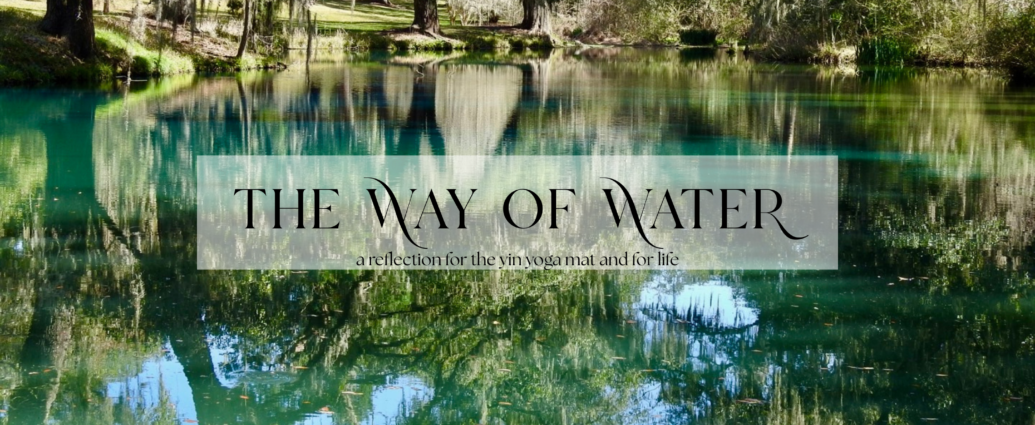
Anyone who knows me knows I spend a lot of time with water. Oceans, rivers, mountain creeks, and streams are some of my very best friends. My favorite place to visit with the water is a small, slow area of the river close to where I lived in Tennessee. Most people drive right past it or hop out for a photo or two and move on, thinking there’s not much to see. There’s no waterfall, no rapids, no grand vistas…just a quiet, unhurried current pressing against the same limestone (and quartz, feldspar, and sandstone) banks it has been pressing against for thousands of years.
But if you look closely at those banks, you see something extraordinary: the stone has curved. Not cracked, not broken…curved. Smoothed and sculpted by something so soft it can be held cupped in your hands. The river didn’t overpower the stone; it simply kept showing up, over and over and over again.
We live in a culture that worships force. We push through workouts, power through burnout, break through limitations. We talk about “crushing” goals and “attacking” challenges. Even in yoga spaces, we sometimes bring this striving energy to the mat by trying to force flexibility, muscle through long holds, and treating the body like a problem to be solved rather than a landscape to be explored.
But water knows something different.
Water persists. Water flows. It doesn’t force. It simply exists dynamically, without force. And over time, it reshapes stone it touches. Not through aggression, not through overt coercion, but through a patient accumulation of presence.
Fascia, the incredible web of connective tissue that wraps every muscle, bone, nerve, and organ in the body, shares something important with stone: it doesn’t change quickly. Unlike muscle, which responds to acute effort, fascia responds to time and sustained gentle pressure. You cannot force a fascial release any more than you can force a river to carve a canyon in a day. What you can do is show up, hold the pose, breathe into the sensation, and trust that something is shifting…even when you can’t feel it yet.
This is where so many practitioners give up. They hold Dragon for 90 seconds, feel nothing dramatic, and conclude that nothing is happening. But the fascia is listening. The tissue is beginning its slow, hydrophilic conversation with the pressure you’re offering.
The river is touching stone.
Your breath, your thoughts, are beginning the simple, subtle work of smoothing the edges.
And now the question is: will you return tomorrow?
Ovid wrote, “Dripping water hollows out stone, not through force but through persistence.” This is the defining image of a Yin practice, and of any meaningful growth. Persistence in yoga is not the ability to hold a difficult pose. It’s the decision to return to the mat when you don’t feel like it. It’s the willingness to practice on the days when nothing opens, nothing releases, nothing feels profound. It’s showing up the same way in December that you showed up in January.
A river doesn’t take days off because it doesn’t feel like river-ing. It doesn’t give the stone a rest because it feels uninspired. It may slow down, when the feeding creeks are low, but it will always, always, every day, press on. Quietly, continuously, with almost incomprehensible patience. And that continuity is everything.
Your practice is the same. It’s about persistence, not some peak experience. It’s about the unremarkable Thursday when you rolled your mat out anyway, held your poses, breathed your breath, then went to bed…and returned again on Friday. Those Thursdays are where the canyons are made.
Patience has gotten a bad reputation. We’ve conflated it with passivity, with waiting around, with tolerating things that should be changing. We’ve somehow decided as a society that everything should be happening RIGHT NOW.
But true patience is one of the most active, intentional practices available to us.
To be patient is to trust the process so completely that you don’t need to rush it.
Lao Tzu (the legendary sage traditionally credited with writing the Tao Te Ching) understood this, as the Tao Te Ching is, in many ways, a meditation on the nature of water and the paradoxical idea that the softest thing overcomes the hardest. Not by being stronger, but by being more willing to wait, to yield, to return, to find the path that opens rather than forcing one that doesn’t.
In Yin Yoga, patience is a physical practice. Every long hold is an invitation to be with what is- not to fix it, not to improve it, not to rush it toward resolution. The sensation you feel in a three-minute Sleeping Swan is not an emergency. It is information. And patience is the practice of listening to it with curiosity rather than reacting to it with urgency.
Off the mat, this can feel even harder. We want our growth to be legible, trackable, measurable proof that our effort is working. But fascia doesn’t send progress reports. Neither does the deepest work of becoming. The greatest changes are usually imperceptible…until they aren’t.
We must learn to act without immediate evidence, to trust the river even when the stone looks just the same as it did last season.
This practice of showing up again and again and again is how we build resilience.
Most people think resilience is about not being broken. But take a look at a canyon: it is broken, in the most beautiful way. The river didn’t leave the stone unchanged; it moved through it, shaped it, left its mark permanently. And the result is not a wound, but an opening. A depth. A capacity to hold more. More water, more life, more light. Real resilience is not the ability to remain untouched by difficulty. It is the capacity to be changed by difficulty in ways that deepen you rather than diminish you.
Every time you’ve returned to your mat after injury, or illness, or heartbreak, or exhaustion, or doubt…you have been the river. Every breath you’ve taken in a pose that asked more of you than you felt you had…you have been the river. Every time you’ve released rather than gripped, softened rather than braced, let the tide move through you rather than fighting it…you have been the river.
You are not the stone being eroded. You are the water carving a canyon.
There’s a common misunderstanding about flow and flow states in yoga. People think flow means ease. Constant motion. No resistance. Smooth sailing.
But watch an actual river for five minutes. It is never not in dialogue with its environment. It pushes against banks, swirls around stones, slows in shallow beds, quickens through narrows. The river is in relationship with everything it touches. Flow is not the absence of resistance. It is an intelligent, continuous response to it.
This is the invitation of a Yin practice and The Way of Water as a philosophy: not to eliminate the friction from your life, but to develop a different relationship with it. To meet tension not with more tension, but with curious, sustained presence. To find the path that opens by staying in contact with the stone long enough that it begins to speak.
In our bodies, this is literal. The fascia is our body’s system for proprioception, for fluid distribution, for communication between systems. When we hold tension in the fascia, when we’ve been braced for so long we’ve forgotten we’re bracing, we interrupt the body’s natural conversation with itself. We silence our internal signals. Yin Yoga invites us back into that conversation. It asks us to become fluid again in the places we’ve calcified.
We adopt the ways of water and begin to ask the questions: Where in your life have you become stone? Where have you been so long in resistance that you can no longer feel what you’re resisting? What would it mean to soften there…not surrender, but soften…and let the water begin its patient work?
Over the next three days, we will move slowly. We will hold poses that ask patience. We will work with fascia in ways that require trust rather than force. We will breathe into the places that feel most immovable.
Yin is a training in fluidity, rather than flexibility. This isn’t about how far your body can bed, it’s about whether you can stay present even when the body is begging to flee.
Every long hold this weekend is an invitation: Can you be the water? Can you stay in contact with the stone- the sensation, the resistance, the discomfort- without withdrawing, without bracing, without trying to force an outcome? Can you trust that your patient, persistent presence is doing something, even when you can’t see it yet?
The river doesn’t know what the canyon will look like. It simply flows.
That is enough.
That has always been enough.
Lao Tzu wrote that water is the most powerful thing in the world precisely because it makes no claim to power. It seeks the lowest place. It yields to every obstacle, then surrounds it. It is patient beyond measure, and persistent beyond comprehension. And in the end, it outlasts everything.
You came to this practice for many reasons. Maybe you wanted to move better, feel better, understand your body more deeply. Maybe you came because something in you needed to slow down, to be held, to find a quality of presence that daily life doesn’t always offer. Maybe you felt the call to find a more easeful path.
Maybe the water within you awakened.
Because it IS there, in you. It has always been in you.
This weekend, we practice remembering.
Flow Well, Knowmads.
This article was written for participants of “The Way of Water,” a 3-day fascia and Yin Yoga immersion.


